Marshall Bierson
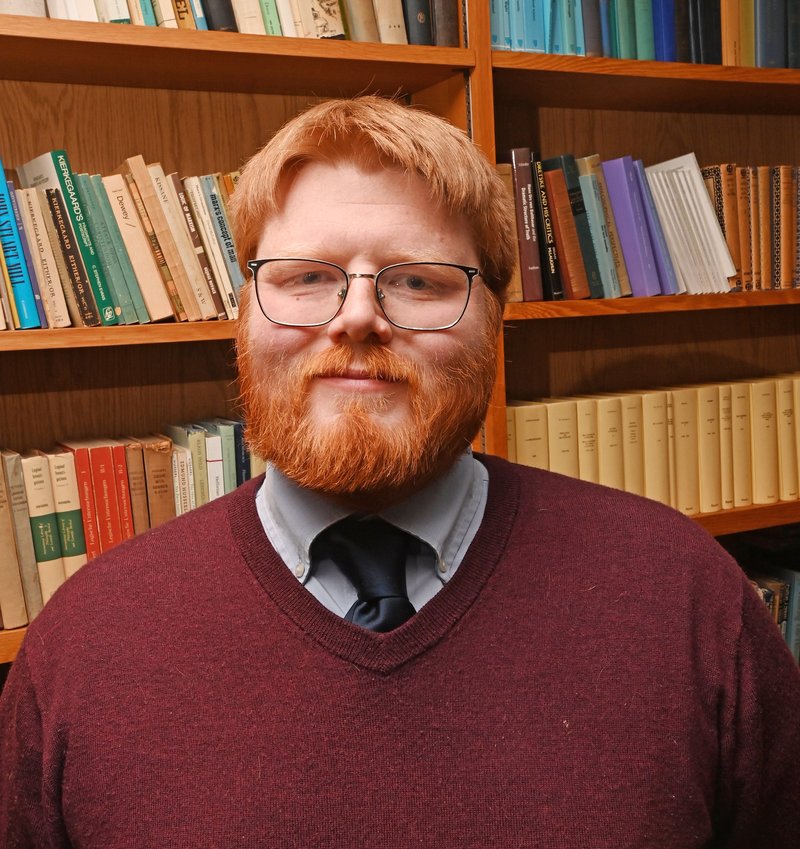
I’m an Assistant Professor of Philosophy at the Catholic University of America.
My research aims to advance Elizabeth Anscombe's project of securing ethical theory in an adequate philosophical psychology. Put less technically, I want to understand how what we are informs how it is that we should live.
I believe that answering these questions often requires both the empirical methods of cognitive science as well as the a priori methods of wittgensteinian grammatical inquiry. I'm particularly interested in understanding how it is that these two ways of knowing can reveal one and the same thing known.
Is C.S. Peirce correct that the "true scientific eros" desires to understand possibility, rather than actuality. And to what extent is this just the same as saying we want to know the eternal forms or unchanging mind of God?
But if you enjoy the good fortune of talking with a number of mathematicians of a high order, you will find that the typical pure mathematician is a sort of Platonist. Only, he is a Platonist who corrects the Heraclitan error that the eternal is not continuous. The eternal is for him a world, a cosmos, in which the universe of actual existence is nothing but an arbitrary locus. The end that pure mathematics is pursuing is to discover that real potential world. ...
The soul's deeper parts can only be reached through its surface. In this way the eternal forms, that mathematics and philosophy and the other sciences make us acquainted with, will by slow percolation gradually reach the very core of one's being; and will come to influence our lives; and this they will do, not because they involve truths of merely vital importance, but because they are ideal and eternal verities.
— C.S. Peirce, Collected Papers 1.646–648